

Fall Foliage Trips — Call for Availability!

One Caney Fork River. Two Very Different Stories
Most people who know Center Hill Lake know it as a lake. Long coves. Steep wooded hills. Water so deep and green it seems as if it has always been there.
It hasn’t.
Under all that water is a river. The Caney Fork once ran freely through this valley, past farms and church houses, schoolhouses and family cemeteries. Then, in the late 1940s, the valley began to fill.
If you have heard the stories told on our Haunted Canoe Trip at Cemetery Cove, you already know the lake has a way of keeping things. This is the other half of that story: the river that became the lake, and the river that still runs below the dam.

Before there was a lake
People were living along this river long before the farm families came. In 1947, just before the valley flooded, a Smithsonian team surveyed it and recorded 39 archaeological sites, including Native American villages and three temple mounds. The mounds were built by the people archaeologists call the Mississippian culture, most likely around 800 to 1,000 years ago. At the mouth of Mine Lick Creek, Native people had lived almost continuously for about 1,500 years. Those places are under the lake now, too.
Then came the settlers. For generations, their families farmed the valley. They built homes and barns along the bottomland, raised churches and schools, and buried their people on the hillsides nearby.
The river gave them rich soil. It also flooded. The Caney Fork could rise fast and hard, and the floods reached well beyond this valley, all the way down the Cumberland.
In 1938, Congress authorized a dam on the Caney Fork to control those floods and, eventually, to produce electricity. Work began in 1942. It stopped a year later, when the steel and workers were needed for the war, and started again in January 1946.
Meanwhile, the families in the valley were preparing to leave.
What had to be moved
Homes were taken down or hauled away. Churches and schools were closed. And crews dug up the graves they could find, one family cemetery after another, and carried them to new ground above the coming waterline.
Arminta Carter Woods was 12 when her family left Love Bottom, near today’s Hurricane Boat Dock. Her grandfather’s grave was moved to higher ground. “I didn’t realize how traumatic it was going to be until we started packing everything up,” she said years later. When the family went back for the things they had left in the house, they were gone.
People who have spent years studying the lake’s history estimate that more than 5,000 graves were relocated. Some families are still trying to learn where their ancestors were taken.
On November 27, 1948, the gates of Center Hill Dam closed. Slowly, the Caney Fork backed up into its own valley and covered roughly 18,000 acres where farmhouses, barns, schoolhouses and churches had stood. By the end of 1949, the lake was full.
The official record says the graves were moved. Locals tell it differently. They say not every grave was found, and that some were left behind for the water to cover.
Leann Judkins grew up spending weekends at a log lake house high above Hurricane Bridge. Writing in the Smithville Review in 2025, she remembered that her father “…would never let my sister, Lucy and me swim in the lake’s waters because of ‘what might be down there.'”
The stories told at Cemetery Cove go further still. We’ll leave those where they belong: on the water, after dark, with a storyteller beside you.

The river that kept going
Here is the part many visitors never think about: the Caney Fork did not end at the dam. It simply changed.
Below Center Hill Dam, the river keeps flowing, past bluffs and bends and gravel bars, on its way to the Cumberland. That is the Caney most of our paddlers know. Daylight on the water. Herons along the banks. The steady pull of the current carrying you downstream.
And the water itself remembers where it came from. Because it is released from deep in the lake, the river below the dam runs cool, even when the air above it is warm. In late October, that cool water and the changing color along the banks make for a different kind of river day than you would find in July. Not better. Just different, and worth seeing.
Two ways to know the Caney
So the same river gives you two experiences.
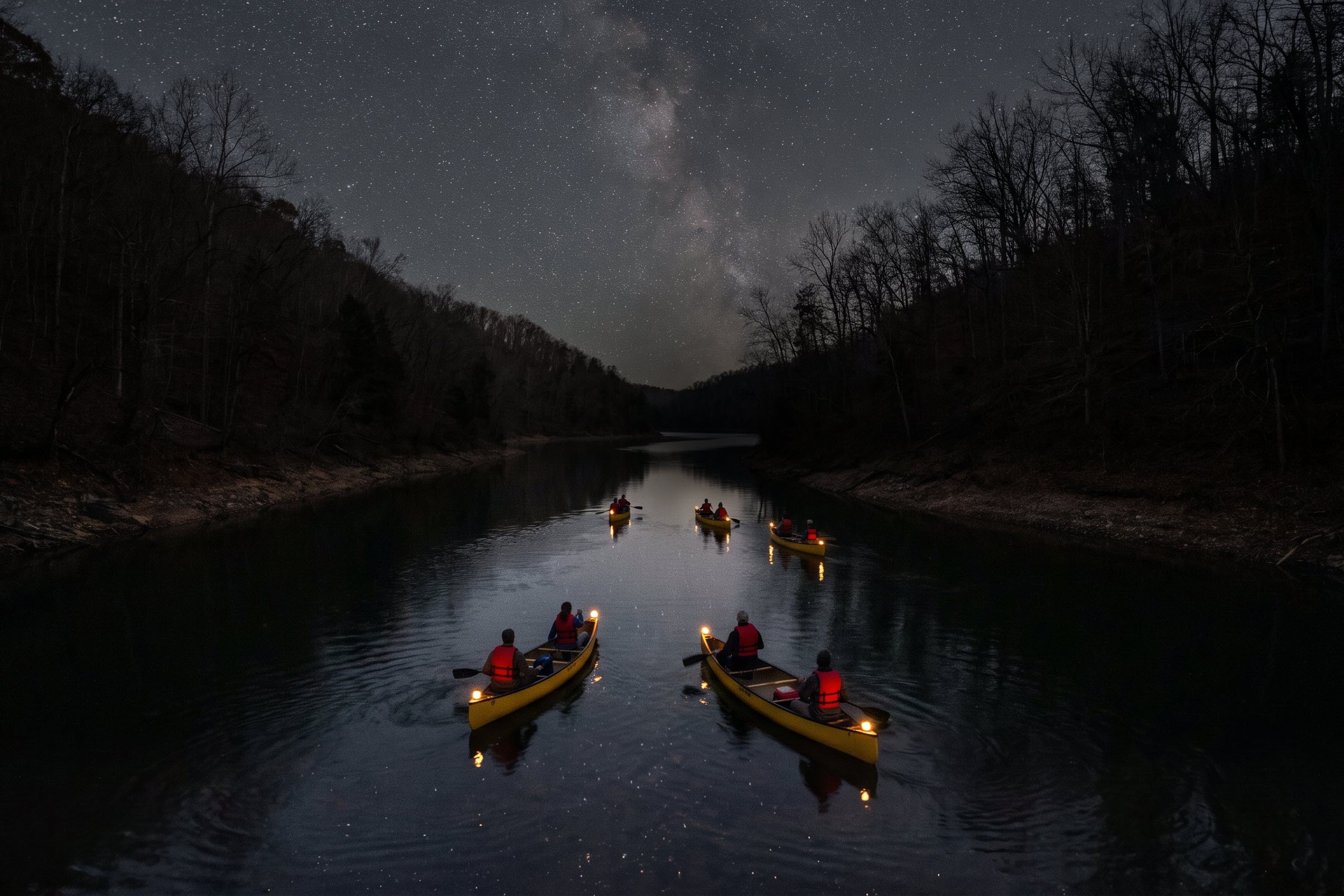
Above the dam, after dark, there is the lake: lighted canoes, a guided walk through an old cemetery, and stories told in the places where they happened.
Below the dam, in daylight, there is the river: moving water, open sky and the sound of your paddle as the bluffs slide past.
One is about what the water covered. The other is about where the water is still going. Together, they tell you more about the Caney Fork than either can tell you alone.
Come see both sides
StyleBlueprint called the Haunted Canoe Trip “…part ghost story, part history lesson, and part test of your courage.” This post is part of the history lesson. The rest you’ll have to find on the water.
This is the season for the Haunted Canoe Trip. Choose your night, bring someone who loves a good story and book your Haunted Canoe Trip.
If you’d like a taste of the stories first, read What the Water Remembers.
Then come back in daylight and meet the river that kept going. Explore Canoe the Caney’s trips and choose your day on the Caney Fork.
Some rivers simply run. This one carries its history with it.

Related Posts


Great Family Fun, all Season Long. Limited Availability!


Our Location
Directions
1 Mile Off I-40 Exit 273
17055 Smithville Hwy Silver Point, TN 38582 USA 1-800-579-7893